
Patient Dynamics
Better Patients. Better Practices.
The shift from pain relief to sustained health engagement. When patients progress instead of cycling, everything changes.
The problem
The hidden ceiling of pain-based practice
When care revolves around episodes, the practice hits a wall: you are managing visits, not patients. The moment you stop acquiring new patients, the practice stops growing.
There is no compounding. No retention engine. No trajectory.
The pain loop
Every episode resets to zero.
The shift
From reactive care to managed progression.
Patients progress
rather than cycle
Engagement becomes intentional
rather than episodic
Outcomes improve
because care has a direction
The goal is not visits
the goal is movement
The new standard
The Patient Dynamics journey
Not abstract. A precise, repeatable sequence that turns a scan into a trajectory.
Brain Check
The scan. An objective, multi-channel look at how the nervous system is responding — something symptoms alone can’t show.
Neural Intelligence
The Four Axis Report. Data interpreted through the framework into a clinical story the practitioner can act on and the patient can understand.
Neural Profile
The patient’s Neural Profile classification. Where they are in the map. This is the starting point for everything that follows.
Care Frequency
The practitioner’s individualized action plan. Frequency, modality, home plan. Not one-size-fits-all — informed by objective Neural Profile data.
Patient Map
9-box classification tracking movement over time. Width, depth, and length of engagement — made visible and manageable.
The economic model
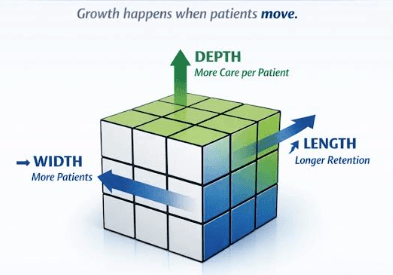
Growth is multiplicative, not additive.
Most practices think about growth in one dimension: get more patients. The Cubic Patient Map reveals that practice revenue is a product of three dimensions simultaneously.
Width × Depth × Length = exponential impact.
What changes when you manage movement
Patients stay longer because care has a direction they can understand and follow.
Value per visit increases naturally as patients progress through care phases.
Retention improves because sustained health engagement replaces episodic pain relief.
Revenue stabilizes because the patient base compounds rather than resets.
Growth becomes multiplicative rather than additive.
The practice builds equity — not just volume.