
Save the date
BALANCE 2027 · DoubleTree by Hilton · Jacksonville, FL
February 5–6, 2027

From signals to strategy
You were right about
the nervous system.
It holds the answers. Now there's a way to see them clearly, interpret them confidently, and act on them precisely.
Neural Profile
Coherent
Working Together
Four Axis response pattern
The hidden ceiling
Most practices are built on a model that resets to zero.
A patient arrives in pain. They receive care. The pain resolves. They disengage. Then the cycle repeats — if they come back at all. There's no continuity. No progression. No compounding value.
The pain loop
Every episode resets to zero. No data accumulates. No trajectory emerges.
Managed progression
Patients progress rather than cycle. Care becomes intentional, measurable, and cumulative.
The Four Axis Framework
Four dimensions. One complete picture of how the nervous system works.
Twenty years of clinical data distilled into a framework that transforms complexity into clarity. Every scan tells a story across four essential dimensions.
Set Point
Where does the system rest? The baseline state reveals whether the nervous system is running too hot, too cold, or in balance.
Reactivity
How does it respond to challenge? Sensitivity to stress, speed of response, and appropriateness of the reaction.
Recovery
Can it return to baseline? The most critical axis. Resilience, restoration, and the ability to self-regulate after demand.
Trainability
Can it learn and adapt? The capacity for long-term neurological change. The difference between managing and transforming.
The transformation
From raw data to clinical confidence.
The same scan data that used to overwhelm now tells a clear story. Four steps from measurement to meaningful action.
Signals
Raw nervous system data across seven modalities
Patterns
The Four Axis Framework reveals what the data means
Profiles
Ten Neural Profiles describe the nervous system state
Strategy
Personalized care plans that create measurable movement
Neural Profiles
Ten profiles. A common language for the nervous system.
Every patient maps to one of ten Neural Profiles. Each profile tells you where the nervous system is, why it's there, and what to do about it.
Running hot
4Defended
On Guard
Slow to Settle
On Guard, Slow to Settle
Braced
Stuck at the Top
Wired
Always Switched On
Running low
2Depleted
Running on Empty
Blunted
Slow to Engage
Swinging or out of step
2Instable
Easily Thrown
Decoupled
Out of Sync
Settled, or not one pattern
2Coherent
Working Together
Mixed Pattern
A Unique Mix
20+
Years of Clinical Data
7
Simultaneous Modalities
4
Axes of Function
10
Neural Profiles
The instrument
Research-grade. Clinic-ready.
Built on Thought Technology's FlexComp Infiniti — the same clinical- and research-grade encoder trusted in labs and practices worldwide — paired with stress-response evaluation protocols refined over two decades. Research-grade signal, captured with the fidelity the nervous system demands.
10
Data channels
2048 Hz
Sample rate
14-bit
Resolution
7
Modalities
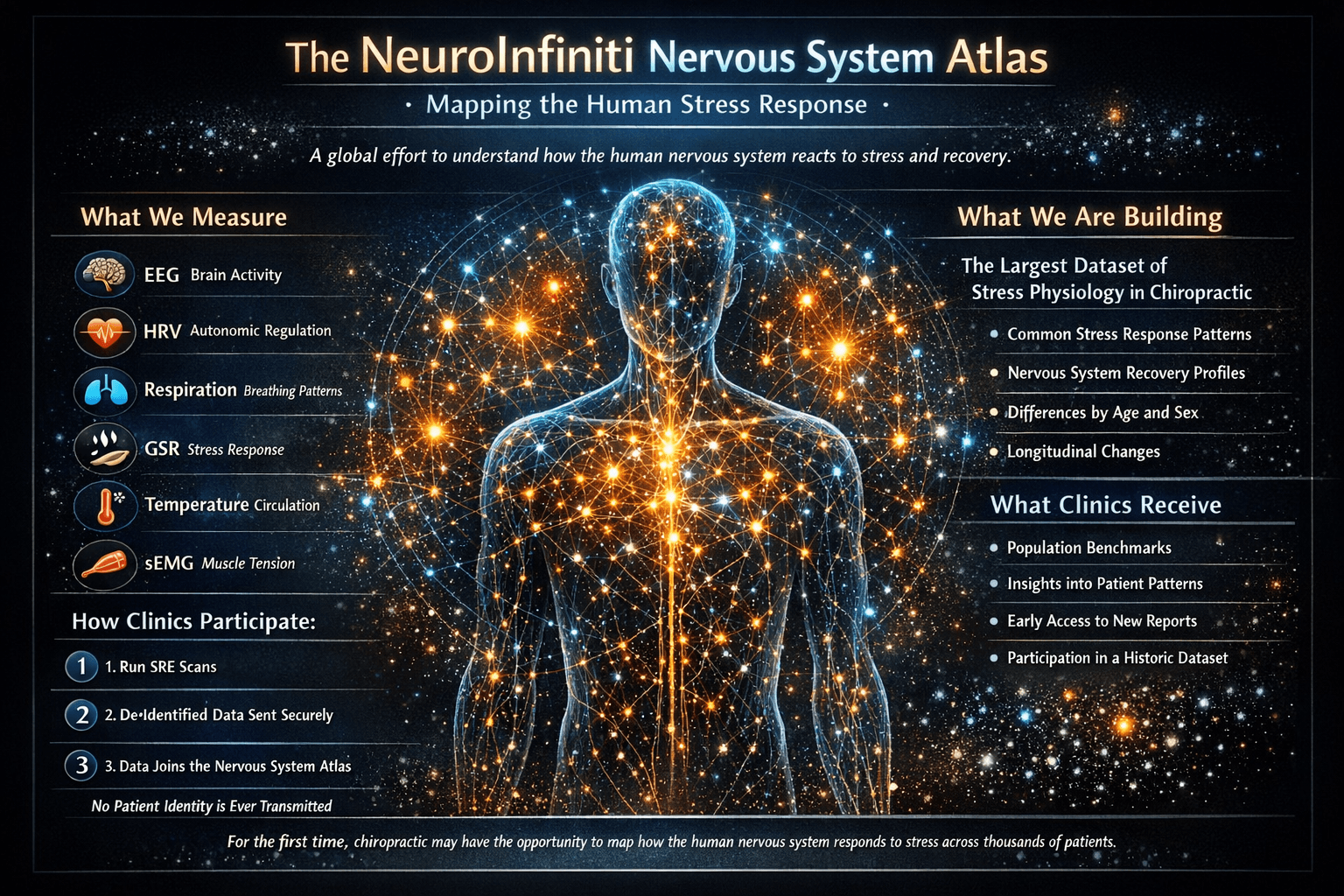
The Atlas Project
Building the largest dataset in stress physiology in chiropractic.
A multi-site clinical research network studying the Four Axis Framework and building normative reference ranges. Developed with a select group of neurologically-focused practitioners who are actively testing and refining the model in practice.
Dr. Richard Barwell
What the brain has been trying to tell us
When I built the first version of what would become the NeuroInfiniti, the goal was embarrassingly modest. I was trying to answer one question: does a chiropractic adjustment affect brainwaves?
What I did not anticipate was what happens when you build a sensitive enough instrument and then spend twenty years listening carefully to what it has to say. It talks back.
The Four Axis Framework did not come from a theory we set out to prove. It came from twenty years of patterns we could not stop seeing.
Join the movement
See what others can't.
Know what others don't.
The practitioners using this framework aren't just running scans. They're building practices on a foundation of objective nervous system intelligence — and their patients can feel the difference.